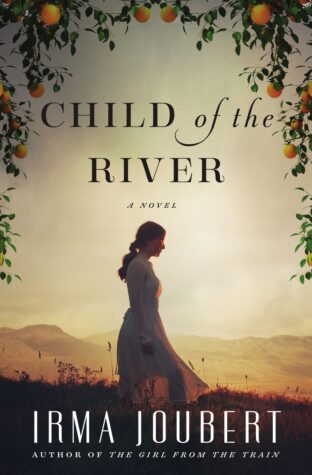
 Child of the River by Irma Joubert
 Series: Dochters van Zuid-Afrika #2
Published by Thomas Nelson on October 18, 2016
Genres: Fiction / Christian / Historical, Fiction / Coming of Age, Fiction / Historical / 20th Century / World War II & Holocaust, Fiction / Women
Pages: 416
Format: Audiobook
Amazon|Barnes&Noble|Goodreads
A timeless coming-of-age tale of heartbreak and triumph set in South Africa at the dawn of apartheid.
Persomi is young, white, and poor, born the middle child of illiterate sharecroppers on the prosperous Fourie farm in the South African Bushveld. Persomi’s world is extraordinarily small. She has never been to the local village and spends her days absorbed in the rhythms of the natural world around her, escaping the brutality and squalor of her family home through the newspapers and books passed down to her from the main house and through her walks in the nearby mountains.
Persomi’s close relationship with her older brother Gerbrand and her fragile friendship with Boelie Fourie—heir to the Fourie farm and fortune—are her lifeline and her only connection to the outside world. When Gerbrand leaves the farm to fight on the side of the Anglos in WWII and Boelie joins an underground network of Boer nationalists, Persomi’s isolated world is blown wide open. But as her very small world falls apart, bigger dreams open to her—dreams of an education, a profession, a native country that values justice and equality, and of love. As Persomi navigates the changing landscape around her—the tragedies of war and the devastating racial strife of her homeland—she finally discovers who she truly is, where she belongs, and why her life—and every life—matters.
The English language publication of Child of the River solidifies Irma Joubert as a unique and powerful voice in historical fiction.
“Filled with lessons of grace and love, Child of the River is a story that reminds us all to hold steady through life’s most fragile hours.” —Julie Cantrell, New York Times and USA TODAY bestselling author of Perennials
I think, for me, something got lost in translation with this book. First, the book was translated to English, then I picked up the audio version, and here I am feeling like I missed something big and broad. But I did get the smaller and important . . . I think. Set in South Africa, this is not an Americanized telling. I appreciated that, but it did make it a bit more difficult due to culture references and political references that I didn’t correlate to. Add that with the names, and I think some cultural naming conventions, the audiobook didn’t do much to help me dig deeper into understanding. Though honestly, the narrator was amazing for this book. The reality is that I know exactly three things about South Africa: British Colony, Apartheid, and Nelson Mandela. This book was a glaring reminder that I have a lot to learn.
Persomi (can we take a moment to appreciate how much I LOVE that name – sounds soo soothing on the audio). Girl started with nothing, has nothing but for being very intelligent, not even a clue who her father is. Spanning from WW2 through the late 60s, Persomi is given some opportunities to further her education and become an attorney, something she decided to do when she was young and before opportunities. She’s also an idealist. As Apartheid takes the reigns she disagrees with so much, to the degree that she chooses to represent the Indian Muslims against the ordinances that are forcing them to move from the city center. There’s a lot to unpack in this book, a lot that deepened my understanding of some things, and a lot that makes me interested in learning more. More about WW2 on the different fronts (seems like everything is set in England or France that I’ve read), more about the culture and politics of South Africa. Just a heads-up: this is the second book in a trilogy, but I wasn’t able to readily find a translation of the first book. The third book is already queued up and ready to be read.
I’m having a hard time articulating my thoughts on this book because I just struggled to connect. I loved the growth and perspective of Persomi, but I did struggle with more than just translations and not understanding everything due to lack of my own knowledge. I struggled with the lack of real emotion. There’s a lot of emotional things that happen in this book that could have really and truly made me feel. Feel the pain, the happiness, even the embarrassment, but I got all the words, and I got the story, but I didn’t get the feels. The book is slow-paced, despite covering so many decades; it didn’t bother me as it did (mostly) flow well, but that could be a turn-off to others. Overall, I really enjoyed this book. It taught me things I didn’t know I needed to know, and it really reminded me that I really am not very world-cultured, and that’s something I think I want to explore more in my reading life.

About Irma Joubert

“Writing and telling stories, that’s like breathing for me,” says Irma Joubert. “It’s not a matter of making sense or getting to work. I experience it as a necessary thing, an urge that is stronger than myself. Writing is in my blood. I just have to tell you. If God is gracious to me, there will always be a story waiting for me again, a story to be told.”
Before she puts a letter on paper, Irma first has an intensive period of introduction and research (as a former teacher of history, she finds a correct representation of historical facts very important). During this period, she hangs out with her characters for months. She imagines what place her characters occupy in the facts she examines, she has conversations with them about what she has come to know, and so on.











Wanna share your thoughts? Leave a comment!